Jiu Ju Magnetizer


Smart Automation: Paving the Way to Success
Pioneering Industrial Advancement with Intelligent Solutions
Full Site Search
Pioneering Industrial Advancement with Intelligent Solutions
The "Frequently Asked Questions" section for Jiuju magnetizing machines compiles the most common questions raised by customers during the purchasing and usage process. The content covers a wide range of practical topics—including equipment selection, compatible materials, operating environments, operating procedures, daily maintenance, troubleshooting, and customization options—presented in a clear and easy-to-understand manner. It provides comprehensive answers to questions regarding different operational requirements, magnetization process combinations, and equipment application scenarios, helping customers quickly clarify their purchasing decisions and avoid common pitfalls. At the same time, we continuously update the section with industry-specific expertise and practical experience to resolve various basic challenges encountered in daily production. This one-stop resource answers all types of questions, saving customers the time spent on repeated inquiries and helping them easily select the right equipment, use it properly, and efficiently advance their magnetic material magnetization production operations.

The operating parameters of magnetizing equipment can drift over time, and routine inspections are essential for maintaining consistent quality. This article provides a checklist of key startup inspection items and periodic inspection tasks to help equipment managers establish a practical inspection system.
View Full Version
Ferrite and neodymium-iron-boron exhibit significant differences in coercivity and magnetization difficulty, so it is essential to distinguish between them when selecting materials for mass production. This article compares their magnetic properties, external magnetization fields, and suitable applications to assist manufacturers in making informed decisions.
View Full Version
Stepper motors rely on multipole-magnetized magnets to achieve step-by-step positioning; the quality of the magnetization directly affects step accuracy and operational smoothness. This article discusses the challenges involved in multipole magnetization and the key points for ensuring accuracy.
View Full Version
The magnetizing coil is the core component that converts electrical energy into a magnetic field; the number of turns and wire gauge directly determine the strength of the effective magnetic field. This article explains the key technical points of the winding process to help maintenance and production personnel understand the relationship between coil parameters and magnetizing performance.
View Full Version
Permanent magnets in wind turbines are large and have many poles; the uniformity of their magnetization directly affects power generation efficiency and operational stability. This article explains why magnetization of large permanent magnets focuses more on uniformity than on mere saturation, and outlines the key points for implementing multi-pole, integrated magnetization.
View Full Version
Magnetization equipment generates strong magnetic fields through instantaneous high-current discharges, making grounding and safety precautions essential for safe operation. This article outlines key practical considerations for grounding installation, ground-fault protection, and discharge circuit interlocking to help equipment managers establish basic safety standards.
View Full Version
The quality of magnetization depends not only on equipment parameters but also on the workshop environment, which is a hidden factor affecting magnetic flux stability. This article discusses the impact of environmental management on magnetization stability and outlines corresponding countermeasures, focusing on three aspects: temperature, humidity, and dust.
View Full Version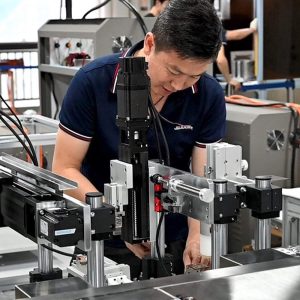
Magnetization Equipment involves certain high-voltage and strong magnetic field risks, so new employees must undergo systematic training before starting work. This article uses five steps to explain how to help new employees quickly master standard operations and safely operate the equipment independently.
View Full Version
Single-station and multi-station rotary magnetization are two common layouts for batch production of magnetic materials, with the core difference lying in production rhythm and equipment footprint. This article compares them from three aspects — consistency, footprint, and changeover flexibility — to help producers choose based on actual capacity.
View Full Version
Pulsed magnetization and DC magnetization are two mainstream magnetization methods. This article compares them across four dimensions — magnetization magnetic field strength, applicable magnetic materials, magnetization speed, and equipment cost — to help procurement engineers quickly determine which magnetization method better suits their production line needs.
View Full Version Chinese Chinese
 English
 Russian
 Vietnamese
 Korean
 Thai
 French
 Spanish
 Japanese
 Hindi
 Bengali
 Portuguese