 Jiu Ju Magnetizer
High precision requirements for servo motor magnetization? How specialized equipment adapts
End-to-End Solution for Magnetization Automation
Automated Magnetic Charging Integrated Solution
1. How high is the servo motor's requirement for magnetization accuracy, and why is it difficult for conventional equipment to meet it?
In order to realize 0.001mm level positioning for industrial robots and millisecond speed response for precision machine tools, the magnetization accuracy is the core performance guarantee. Magnet density deviation needs to be controlled within ±0.5% (ordinary motor requirements for ±1.5%-2%), once out of range, it is easy to generate torque pulsation, resulting in vibration and noise abnormalities during equipment operation; multi-pole magnetization (e.g., 16-pole, 32-pole) scenarios, if the pole pitch deviation is more than 0.01mm, it will result in the position of the encoder and the magnetic field mismatch, triggering positioning deviation. Positioning deviation will be caused if the deviation of pole pitch is more than 0.01mm. In the case of a machine tool servomotor, for example, an uneven distribution of magnetic density can increase the dimensional tolerances of a machined part by more than three times. Conventional magnetizing equipment can only achieve a magnetic density control of ±1%, which is not able to meet this high standard, and JUJI magnetizing equipment is developed and designed to meet this demand.

2. What are the special technical solutions for JiuJu magnetizing equipment to cope with the problem of magnetic density uniformity?
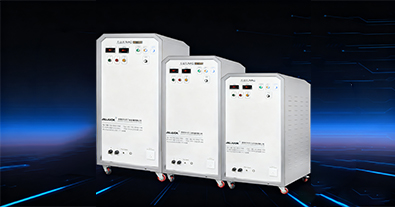
JiuJu magnetizing equipment adopts the dual core technology scheme of "high precision magnetic circuit design + intelligent magnetic control system": Firstly, the magnetic pole head is processed by nano-scale grinding, with the curvature error of each pole controlled within 0.003mm, and paired with JiuJu's patented "double-winding homogenizing coil With the patented "double-winding uniform magnetic coil" (multi-stranded enameled wire layered parallel winding structure), the fluctuation of magnetic field strength in the magnetized area can be controlled at ±0.2%, which improves the accuracy by 40% compared with the conventional equipment in the industry; Secondly, the equipment is built-in with the "Magnetic Density Real-Time Monitoring Module" independently researched and developed by JiuJu, which dynamically adjusts the magnetic field output through Hall sensors in the process of magnetizing to prevent the magnetic field output from falling off. Secondly, the equipment has built-in "magnetic density real-time monitoring module" developed by JUJU, which can dynamically adjust the magnetic field output through Hall sensors during the magnetization process, avoiding the problem of low local magnetic density caused by the difference in magnet materials. After a robot servo motor manufacturer applied this equipment, the standard deviation of magnetic density of magnet steel was reduced from 0.9% to 0.35%, the amplitude of motor torque pulsation was reduced by 30%, and the operation noise was controlled below 58dB.
3.Multi-pole magnetization "pole distance deviation" industry pain point, how to realize the precision control of JiuJu equipment?
In the process of servo motor multi-pole magnetization, the pole distance deviation is easy to cause magnetic field phase disorder, JiuJi cracks this problem through the combination of "dual positioning technology + magnetization timing optimization": the mechanical end is equipped with "servo motor shaft hole profiling tooling", the positioning accuracy can reach 0.002mm. The mechanical end is equipped with "servo motor shaft hole profiling tooling", which has a positioning accuracy of up to 0.002mm, guaranteeing the precise alignment of the magnet steel and the pole head; the visual end is equipped with JiuJu's AI visual calibration system, which captures the edge position of the magnet steel in real time, and automatically adjusts the position of the tooling when the deviation is more than 0.005mm; at the same time, the equipment is equipped with a built-in high-precision PLC, which controls the time difference of the magnetizing pulses of all the magnetic poles to be less than 0.8 microseconds, to ensure that the magnetic fields of multiple poles are generated synchronously. Actual test data show that this solution can control the pole deviation stably within 0.006mm, which can fully meet the signal synchronization requirements of 2500r/min high speed servo motors, and improve the common problem of "pole deviation exceeding 0.015mm" of traditional equipment.
4. How to prevent the accuracy from decreasing after magnetization? How to realize the function of "charging and checking" of JiuJi equipment?
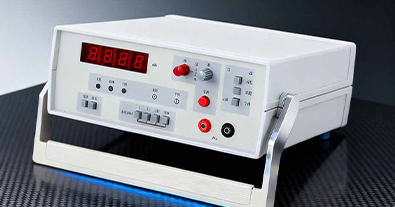
In order to avoid the change of magnetic properties after magnetization which may affect the accuracy, JiuJi magnetizing equipment integrates "Magnetization - Detection - Re-magnetization" as an integrated workflow: after the magnetization is completed, the 16-way Hall array sensors will scan the magnetic field on the surface of the magnet steel within 1 second, generating a three-dimensional magnetic density distribution curve. distribution curve. If the deviation of a certain area exceeds 0.5%, the equipment will automatically start the "local re-magnetization program" to accurately make up the magnetic density; at the same time, all the relevant data (including magnetic field strength, pulse time, test results, etc.) will be bound to the serial number of the servomotor and uploaded to the JiuJi MES system, which is convenient for quality traceability at a later stage. After applying this equipment to a new energy servo motor production line, the pass rate of magnetization was increased from 91% to 99.5%, and the cost of reworking was reduced by 65%, which effectively solved the common industry problem of "unqualified re-inspection after magnetization".
JiuJi magnetizing equipment is supported by the three core technologies of "accurate magnetic control, precision positioning and real-time closed-loop", and the whole process, from demand adaptation to effect verification, is suitable for the high-precision use of servo motors, which provides a key equipment guarantee for the servo motors to reach the core performance in a stable manner.
Magnetization of Magnetic Materials
3C Electronic Magnetization
Motor Rotor Magnetization
Car Speaker Magnetization
New Energy Vehicle Industry
Medical Equipment Industry

Jiuju Magnetization 100 Q&A: What Counts as a Defective Magnet
Nov 10, 2026
Defects in permanent magnets go beyond appearance: magn…
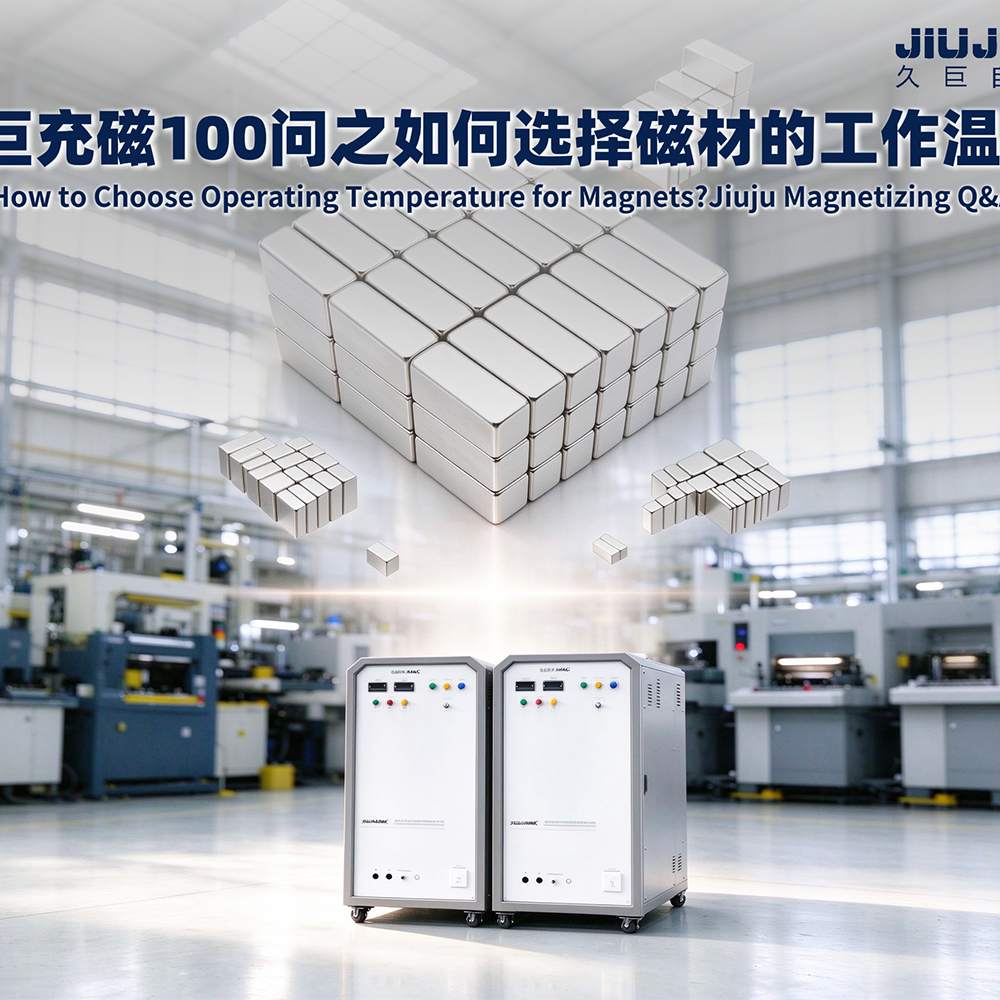
Magnetization 100 Q&A: Choosing the Magnet Operating Temperature
Nov 10, 2026
Operating temperature is the core constraint in magnet …

Precise Magnetization Control for AlNiCo Magnets: Case Video
Oct 30, 2026
AlNiCo magnets keep stable flux thanks to a very low te…

How NdFeB Magnets Achieve Stable Magnetism: Case Video
Oct 9, 2026
Stable NdFeB performance requires the right grade, a co…

轴向磁通电机多极充磁难点在哪?久巨工艺解答
Nov 19, 2026
轴向磁通电机磁钢铺在盘面、磁场垂直盘面、极数又多,难点集中在磁路方向、极间对位与热变形。说明专用轴向极头、角度定位销与多点扫描验收的做法。
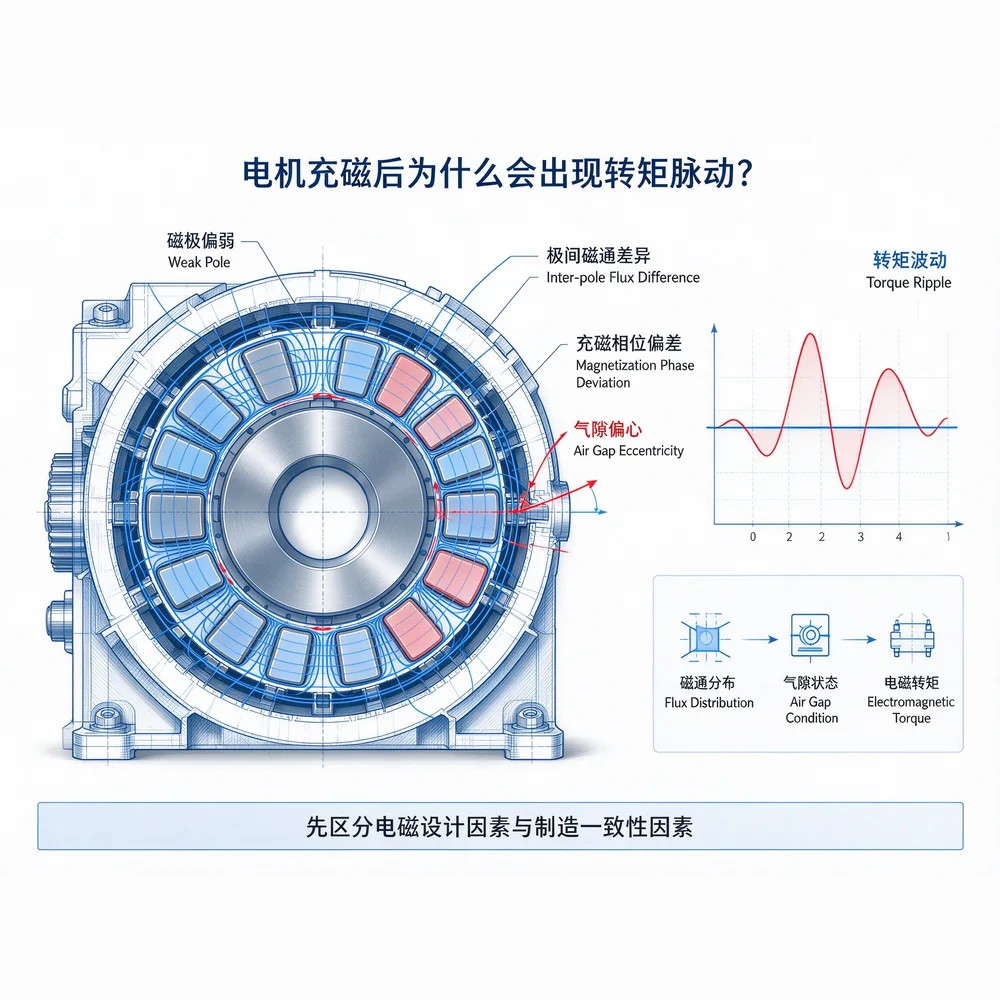
电机充磁后转矩脉动大如何解决?久巨工艺解析
Nov 19, 2026
转矩脉动大要先分清是电磁设计的齿槽转矩还是制造一致性的极间不均。用反电动势与逐极表磁定位,再从极头对位、能量闭环、磁通分组与斜极设计协同改善。
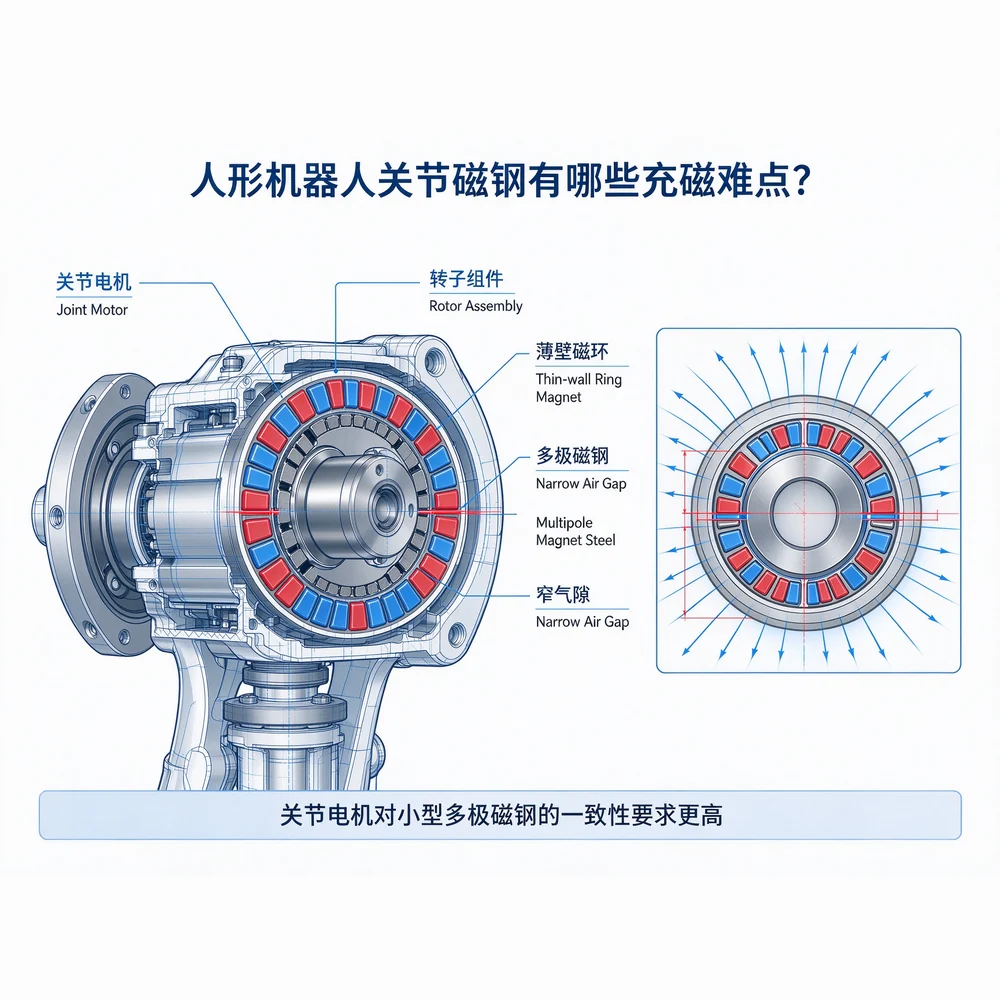
久巨人形机器人关节磁钢怎么保证充磁一致性?
Nov 19, 2026
关节磁钢小、薄、极数多,难点不在能不能充上,而在每一件每一极都一样。分三层管控一致性,用仿形胎具解决薄壁定位,能量闭环全检后按磁通分组配对。
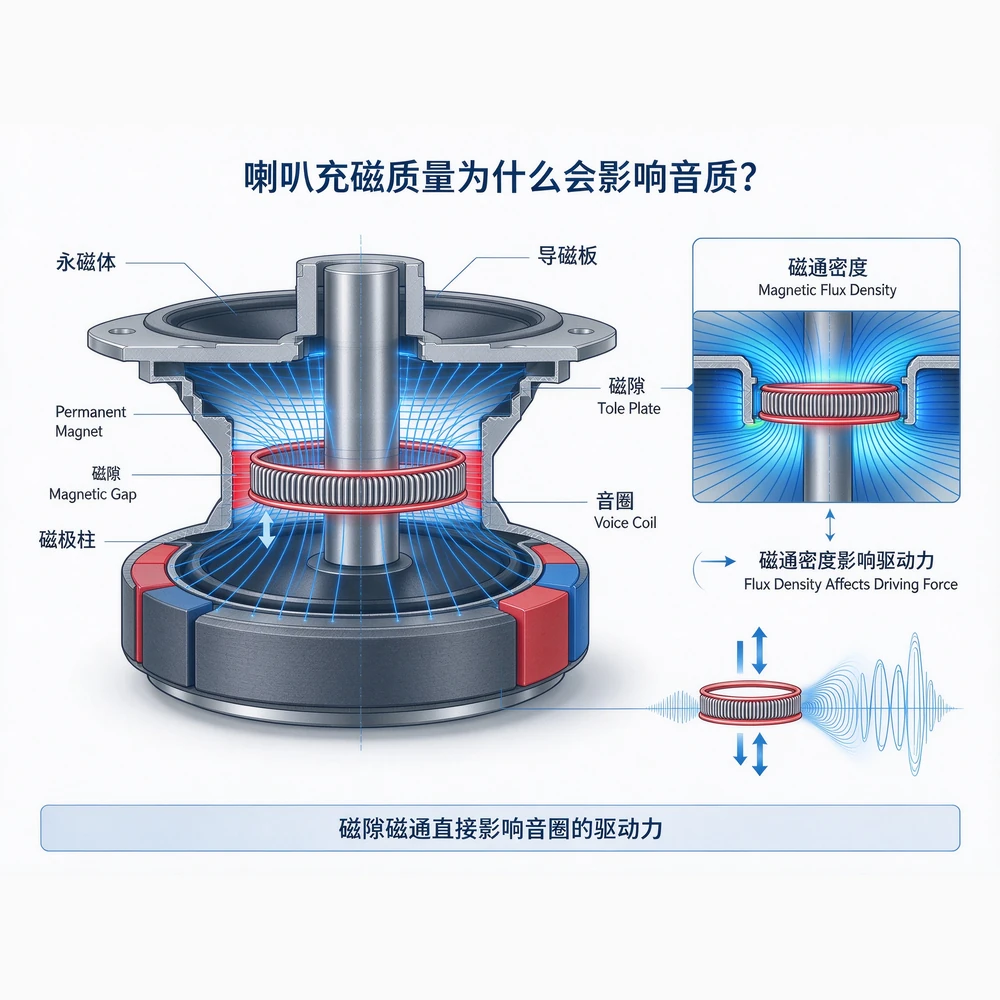
扬声器喇叭充磁后音质差异大怎么办?久巨电声行业答疑
Nov 19, 2026
同一批喇叭充完磁听感不一致,问题常在磁隙磁通而非装配。说明磁通偏低与不均如何影响灵敏度、失真与谐波,以及充磁端四个来源、稳定化处理与分档配对。
轴向磁通电机多极充磁难点在哪?久巨工艺解答
Nov 19, 2026
轴向磁通电机磁钢铺在盘面、磁场垂直盘面、极数又多,难点集中在磁路方向、极间对位与热变形。说明专用轴向极头、角度定位销与多点扫描验收的做法。
电机充磁后转矩脉动大如何解决?久巨工艺解析
Nov 19, 2026
转矩脉动大要先分清是电磁设计的齿槽转矩还是制造一致性的极间不均。用反电动势与逐极表磁定位,再从极头对位、能量闭环、磁通分组与斜极设计协同改善。
久巨人形机器人关节磁钢怎么保证充磁一致性?
Nov 19, 2026
关节磁钢小、薄、极数多,难点不在能不能充上,而在每一件每一极都一样。分三层管控一致性,用仿形胎具解决薄壁定位,能量闭环全检后按磁通分组配对。
扬声器喇叭充磁后音质差异大怎么办?久巨电声行业答疑
Nov 19, 2026
同一批喇叭充完磁听感不一致,问题常在磁隙磁通而非装配。说明磁通偏低与不均如何影响灵敏度、失真与谐波,以及充磁端四个来源、稳定化处理与分档配对。
轴向磁通电机多极充磁难点在哪?久巨工艺解答
Nov 19, 2026
轴向磁通电机磁钢铺在盘面、磁场垂直盘面、极数又多,难点集中在磁路方向、极间对位与热变形。说明专用轴向极头、角度定位销与多点扫描验收的做法。
电机充磁后转矩脉动大如何解决?久巨工艺解析
Nov 19, 2026
转矩脉动大要先分清是电磁设计的齿槽转矩还是制造一致性的极间不均。用反电动势与逐极表磁定位,再从极头对位、能量闭环、磁通分组与斜极设计协同改善。
久巨人形机器人关节磁钢怎么保证充磁一致性?
Nov 19, 2026
关节磁钢小、薄、极数多,难点不在能不能充上,而在每一件每一极都一样。分三层管控一致性,用仿形胎具解决薄壁定位,能量闭环全检后按磁通分组配对。
扬声器喇叭充磁后音质差异大怎么办?久巨电声行业答疑
Nov 19, 2026
同一批喇叭充完磁听感不一致,问题常在磁隙磁通而非装配。说明磁通偏低与不均如何影响灵敏度、失真与谐波,以及充磁端四个来源、稳定化处理与分档配对。
轴向磁通电机多极充磁难点在哪?久巨工艺解答
Nov 19, 2026
轴向磁通电机磁钢铺在盘面、磁场垂直盘面、极数又多,难点集中在磁路方向、极间对位与热变形。说明专用轴向极头、角度定位销与多点扫描验收的做法。
电机充磁后转矩脉动大如何解决?久巨工艺解析
Nov 19, 2026
转矩脉动大要先分清是电磁设计的齿槽转矩还是制造一致性的极间不均。用反电动势与逐极表磁定位,再从极头对位、能量闭环、磁通分组与斜极设计协同改善。
久巨人形机器人关节磁钢怎么保证充磁一致性?
Nov 19, 2026
关节磁钢小、薄、极数多,难点不在能不能充上,而在每一件每一极都一样。分三层管控一致性,用仿形胎具解决薄壁定位,能量闭环全检后按磁通分组配对。
扬声器喇叭充磁后音质差异大怎么办?久巨电声行业答疑
Nov 19, 2026
同一批喇叭充完磁听感不一致,问题常在磁隙磁通而非装配。说明磁通偏低与不均如何影响灵敏度、失真与谐波,以及充磁端四个来源、稳定化处理与分档配对。
轴向磁通电机多极充磁难点在哪?久巨工艺解答
Nov 19, 2026
轴向磁通电机磁钢铺在盘面、磁场垂直盘面、极数又多,难点集中在磁路方向、极间对位与热变形。说明专用轴向极头、角度定位销与多点扫描验收的做法。
电机充磁后转矩脉动大如何解决?久巨工艺解析
Nov 19, 2026
转矩脉动大要先分清是电磁设计的齿槽转矩还是制造一致性的极间不均。用反电动势与逐极表磁定位,再从极头对位、能量闭环、磁通分组与斜极设计协同改善。
久巨人形机器人关节磁钢怎么保证充磁一致性?
Nov 19, 2026
关节磁钢小、薄、极数多,难点不在能不能充上,而在每一件每一极都一样。分三层管控一致性,用仿形胎具解决薄壁定位,能量闭环全检后按磁通分组配对。
扬声器喇叭充磁后音质差异大怎么办?久巨电声行业答疑
Nov 19, 2026
同一批喇叭充完磁听感不一致,问题常在磁隙磁通而非装配。说明磁通偏低与不均如何影响灵敏度、失真与谐波,以及充磁端四个来源、稳定化处理与分档配对。

 English
 Chinese
 Russian
 Vietnamese
 Korean
 Thai
 French
 Spanish
 Japanese
 Hindi
 Bengali
 Portuguese